A Fire TV VPN opens geo-locked libraries, stops ISP throttling, and protects your privacy, but only with a native Fire TV app and speeds that hold up in 4K.
Your Fire TV Stick is a powerful streaming device. But geo-restrictions can wall off a lot of the content you want. A VPN solves this by masking your IP address and routing your traffic through servers in other countries. This makes it appear as though you’re browsing from a different location.
Beyond accessing content, a VPN protects your privacy. It shields your data on public Wi-Fi and prevents your ISP from throttling your connection during heavy streaming. For a broader look at streaming-focused VPNs across all platforms, see our best VPN for streaming guide.
Why You Need a VPN on Fire TV Stick
access geo-restricted content: Access streaming libraries from other countries, including Netflix regions, BBC iPlayer, Hulu and more.
Privacy and security: Keep your data protected from trackers, especially on shared or public networks.
Stop ISP throttling: Prevent your provider from slowing your connection during high-bandwidth streaming sessions.
How Fire TV’s Architecture Affects VPN Compatibility
Fire TV Stick runs Fire OS, Amazon’s fork of Android. This matters because not every Android VPN app works on Fire OS. The Amazon Appstore has a smaller selection of VPN apps than the Google Play Store. Some popular VPN providers don’t publish a Fire TV-specific app at all.
Fire OS also lacks a traditional mouse cursor. You navigate entirely with the Fire TV remote’s directional pad. VPN apps that weren’t designed for Fire TV often have tiny buttons, scrollable menus that don’t respond to the remote, and text fields that require an on-screen keyboard. These issues make setup frustrating and daily use impractical.
Older Fire TV Stick models (2nd generation and earlier) run slower processors. This means encryption overhead from a VPN can drop streaming quality from 4K to 1080p or cause buffering. Newer models like the Fire TV Stick 4K Max handle VPN encryption with minimal performance loss.
Understanding these constraints helps you pick a VPN that actually works well on this device rather than one that just works in theory.
Top VPNs for Fire TV Stick: Native App Performance Compared
The three VPNs below all offer native Fire TV apps in the Amazon Appstore. Each handles the remote-control interface differently, which directly affects daily usability.
ExpressVPN: Simplest Setup and Remote Navigation
ExpressVPN’s Fire TV app installs from the Amazon Appstore. The interface uses large buttons optimized for remote navigation. You connect to a server with three clicks: open the app, select a location, press connect.
ExpressVPN’s Lightway protocol is built for speed on the Fire TV Stick 4K Max, enough for simultaneous 4K HDR streams.
The app auto-selects the fastest server for your chosen country. This removes guesswork when you just want to start streaming quickly.
NordVPN: Strongest Privacy With SmartPlay Streaming
NordVPN’s Fire TV app features a visual server map. Navigating the map with a remote takes some practice, but a “Quick Connect” button sits at the top of the screen for one-click connections.
NordVPN’s SmartPlay technology combines VPN encryption with Smart DNS. This automatically routes streaming traffic through the optimal server without manual configuration. On Fire TV, SmartPlay is designed to access streaming services, including region-locked content on Disney+, BBC iPlayer, and DAZN.
The NordLynx (WireGuard) protocol keeps speeds high. The app also includes a kill switch that blocks internet traffic if the VPN connection drops mid-stream.
Surfshark: Unlimited Devices at the Lowest Price
Surfshark allows unlimited simultaneous connections on a single subscription. If you run Fire TV Sticks in multiple rooms plus phones, laptops, and tablets, Surfshark covers everything without extra cost.
The Fire TV app interface is clean and remote-friendly. Large toggle switches and a favorites list let you save your most-used server locations. WireGuard keeps speeds high enough for 4K streaming on most connections.
Surfshark’s CleanWeb feature blocks ads and trackers at the DNS level. This reduces load times on ad-supported streaming apps like Tubi and Pluto TV.
VPN
Best For
Key Advantage on Fire TV
ExpressVPN
Ease of use
Native Fire TV app, easiest setup experience
NordVPN
Privacy-focused streamers
SmartPlay for geo-accessing, strong encryption
Surfshark
Budget users with multiple devices
Unlimited device connections, lowest price point
How to Choose a VPN for Fire TV Stick
Choosing the right VPN for Fire TV comes down to device-specific factors beyond the usual price and privacy considerations.
Native Amazon Appstore availability. Check whether the VPN publishes a dedicated Fire TV app. Native apps handle remote input correctly. Sideloaded Android apps often don’t.
Remote-control interface design. Open the app’s screenshots or demo videos before purchasing. Look for large buttons, a quick-connect feature, and minimal text input requirements. Entering a 24-character password with a Fire TV remote is painful.
4K streaming performance. Your VPN needs to sustain at least 25 Mbps after encryption overhead. WireGuard-based protocols keep that overhead low, and all three providers above offer one.
Sideload compatibility. If your preferred VPN lacks an Appstore listing, confirm it supports sideloading via the Downloader app or ADB. Not all APK files work on Fire OS without modification.
Router-level fallback. For older Fire TV models that can’t run VPN apps natively, configuring the VPN on your router protects every device on your network. This approach also benefits smart TVs, game consoles, and IoT devices that lack VPN support.
How to Install a VPN on Fire TV Stick
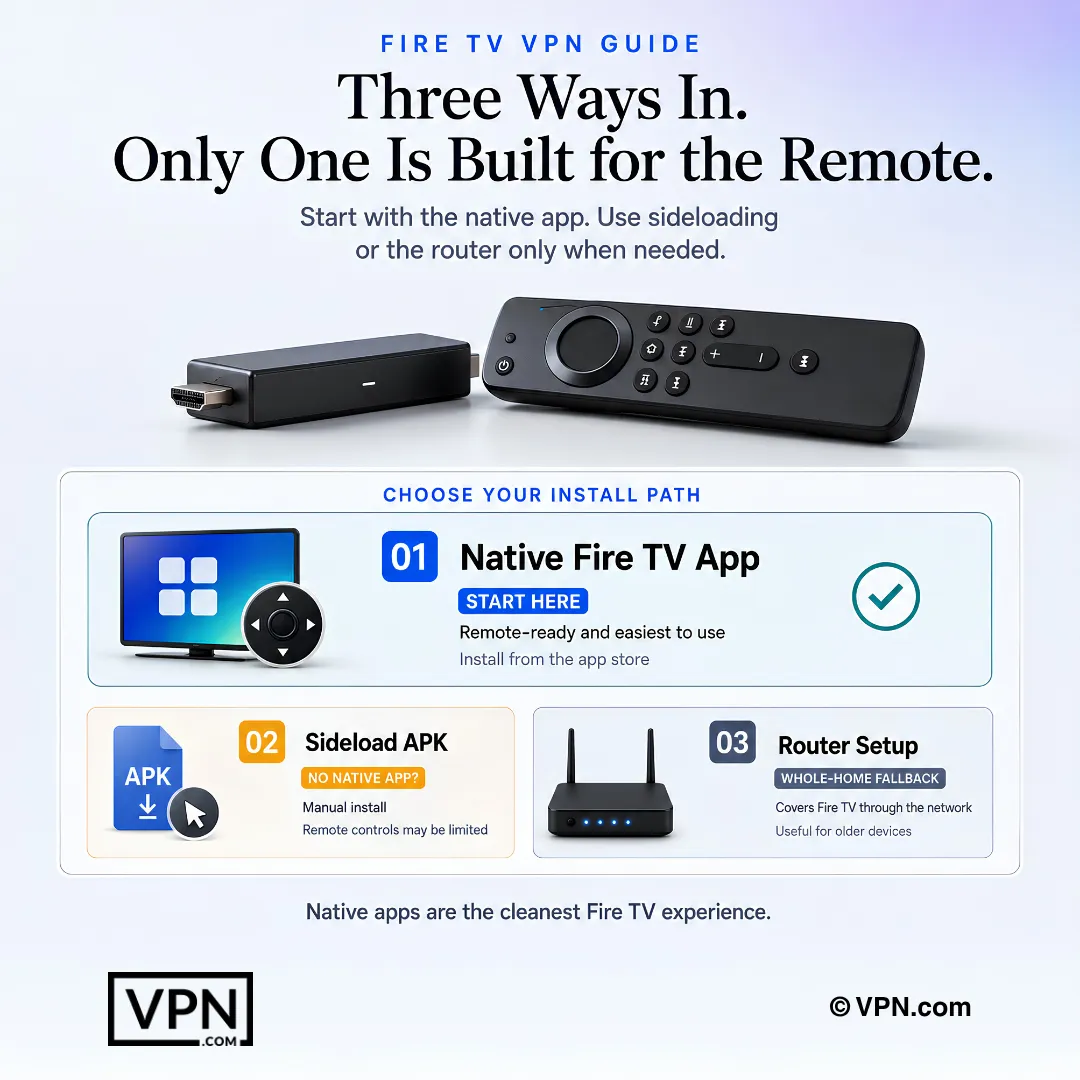
Method 1: Install From the Amazon Appstore
On your Fire TV home screen, select Search (magnifying glass icon).
Type the VPN name (e.g., “ExpressVPN”) using the on-screen keyboard.
Select the app from the results and click Download.
Open the app, sign in with your account credentials.
Grant the VPN permission to create a network connection when prompted.
Select a server location and tap Connect.
The entire process takes under three minutes. This is the recommended method for ExpressVPN, NordVPN, and Surfshark.
Method 2: Sideload a VPN APK via Downloader
Use this method if your VPN doesn’t have an Amazon Appstore listing.
Go to Settings > My Fire TV > Developer Options.
Enable Apps from Unknown Sources.
Install the free Downloader app from the Amazon Appstore.
Open Downloader and enter the direct URL for your VPN’s APK file (find this on the VPN provider’s website).
Download and install the APK.
Open the app and sign in.
Important: Sideloaded apps may not respond correctly to the Fire TV remote. You might need the Mouse Toggle app (also available via sideloading) to simulate a cursor.
Method 3: Configure the VPN on Your Router
For whole-home protection, including older Fire TV models that can’t run VPN apps, set up the VPN directly on your router. ExpressVPN, NordVPN, and Surfshark all provide router-specific firmware or setup guides for popular router brands like Asus, Netgear, and TP-Link.
This approach encrypts traffic from every connected device automatically. The downside: switching server locations requires logging into your router’s admin panel.
Troubleshooting Common Fire TV VPN Issues
Buffering or low resolution after connecting. Switch to a WireGuard-based protocol (Lightway for ExpressVPN, NordLynx for NordVPN). OpenVPN adds more encryption overhead and can drop 4K streams to 720p on slower connections.
VPN app won’t respond to remote input. The app was likely sideloaded and designed for touchscreens. Install Mouse Toggle for Fire TV to simulate a cursor with your remote’s directional pad.
Streaming service detects the VPN. Switch servers within the same country. Most providers rotate IP addresses regularly. NordVPN’s SmartPlay and ExpressVPN’s MediaStreamer are designed to resist detection.
VPN disconnects during long streaming sessions. Enable the kill switch in your VPN app settings. Check that your Fire TV isn’t set to sleep after inactivity, which can interrupt the VPN tunnel.
App crashes on older Fire TV hardware. Older sticks with 1 GB of RAM may struggle with VPN apps running alongside streaming apps. Close background apps before launching the VPN, or use the router-based method instead.
Final Verdict
Pairing your Fire TV Stick with a VPN opens up a significantly larger content library while keeping your connection private and throttle-free. ExpressVPN delivers the quickest setup and most remote-friendly experience. NordVPN adds stronger privacy tools and SmartPlay accessing. Surfshark covers unlimited devices at the lowest price.
Pick based on your priorities: speed, privacy, or budget. All three install directly from the Amazon Appstore and support 4K streaming on modern Fire TV hardware.
Tip: Fire TV Stick supports native VPN apps — download directly from the Amazon Appstore for ExpressVPN, NordVPN, or Surfshark. If your chosen VPN isn't in the Appstore, you can sideload it via the Downloader app. For whole-home protection (including older Fire TV models), configure the VPN on your router instead so every device benefits automatically.
VPN.com does not encourage or condone using VPN services to violate the terms of service of any platform. Information on this page is provided for educational purposes. Users are responsible for complying with the policies of the services they use.
References
Amazon. n.d. Amazon.com: Fire TV Stick streaming device with Alexa built in, includes Alexa Voice Remote, HD, latest release : Electronics. Retrieved September 30, 2026 from https://www.amazon.com/fire-tv-stick.
Private Internet Access, Inc. n.d. Private Internet Access: The Best VPN Service For 10+ Years. Retrieved September 30, 2026 from https://www.privateinternetaccess.com.
Resources for this page
Charts and reference images from our research, free to view and share.
For Fire TV, the native app is the cleanest path, while sideloading and router setup are fallback options.
Why do I need a VPN on Fire TV Stick specifically?
A VPN masks your Fire TV’s IP address and routes traffic through a server in another country, opening geo-restricted libraries like Netflix regions, BBC iPlayer, and Hulu that Fire OS’s Amazon Appstore doesn’t access on its own. It also stops ISP throttling during heavy streaming and encrypts your data on shared Wi-Fi. Fire OS is Amazon’s Android fork, so not every Android VPN app installs cleanly.
How do I install a VPN on my Fire TV Stick?
Open Search on the Fire TV home screen, type the VPN’s name, download it from the Amazon Appstore, sign in, grant network permission, then pick a server and connect. ExpressVPN, NordVPN, and Surfshark all publish native Fire TV apps, and the whole process takes under three minutes. If your VPN isn’t listed, sideload it via the Downloader app instead.
Does Fire TV’s older hardware limit which VPN I can use?
Yes. Second-generation Fire TV Stick models and earlier run slower processors, and VPN encryption overhead can drop streams from 4K to 1080p or cause buffering. Newer models like the Fire TV Stick 4K Max handle encryption with minimal performance loss. WireGuard-based protocols, ExpressVPN’s Lightway and NordVPN’s NordLynx, add less overhead than OpenVPN on constrained hardware.
Which VPN accesses the most geo-restricted content on Fire TV?
NordVPN’s SmartPlay technology accesses streaming services on Fire TV, including region-locked Disney+, BBC iPlayer, and DAZN, by combining VPN encryption with Smart DNS automatically. Its NordLynx protocol supports 4K playback alongside that streaming access. ExpressVPN and Surfshark also stream 4K without buffering on modern Fire TV hardware.
Which VPN delivers the fastest Fire TV streaming performance?
NordVPN ranks #1 of 22 in our Speed Lab, aggregated from published third-party tests, the strongest showing among Fire TV-native options, using its NordLynx (WireGuard) protocol. ExpressVPN’s Lightway protocol is also built for speed on the Fire TV Stick 4K Max, enough for simultaneous 4K HDR streams.
Which VPN is best if I run multiple Fire TV Sticks in different rooms?
Surfshark supports unlimited simultaneous device connections on one subscription, covering multiple Fire TV Sticks plus phones and laptops without extra cost, from $2.49/month on its longest-term plan. NordVPN caps at 10 simultaneous devices and ExpressVPN at 10 to 14 depending on plan, both sufficient for smaller households but less flexible than Surfshark’s unlimited model.
What do I do if the VPN app won’t respond to my Fire TV remote?
This usually means the app was sideloaded and built for touchscreens rather than remote navigation. Install the Mouse Toggle app, also available via sideloading, to simulate a cursor with your remote’s directional pad. Native Amazon Appstore apps from ExpressVPN, NordVPN, and Surfshark are designed with large buttons and quick-connect features for remote-only navigation, avoiding this issue entirely.
What if my Fire TV stream buffers or drops resolution after connecting to a VPN?
Switch to a WireGuard-based protocol, Lightway on ExpressVPN or NordLynx on NordVPN, since OpenVPN’s heavier encryption overhead can drop 4K streams to 720p on slower connections. Older Fire TV Stick models with 1 GB of RAM may also struggle running a VPN alongside a streaming app, so close background apps first or switch to a router-level VPN setup instead.
Can I sideload a VPN onto Fire TV if it’s not in the Amazon Appstore?
Yes. Enable Apps from Unknown Sources under Settings, My Fire TV, Developer Options, install the free Downloader app from the Amazon Appstore, then enter your VPN provider’s direct APK URL to download and install it. Sideloaded apps may not respond correctly to the remote, so you may also need the sideloaded Mouse Toggle app to simulate a cursor.
Which VPN gives the best value for streaming on Fire TV?
CyberGhost starts from $2.19/month on its longest-term plan, the lowest entry price among Fire TV-native options here, backed by a 45-day money-back guarantee, longer than the 30-day standard. Surfshark starts from $2.49/month with unlimited device connections. NordVPN starts from $3.49/month and ExpressVPN from $2.99/month, both on their longest terms, adding stronger streaming or speed credentials.
What’s the refund window if a VPN doesn’t perform well on my Fire TV?
CyberGhost offers the longest window at 45 days, versus the 30-day money-back guarantee standard across NordVPN, ExpressVPN, and Surfshark. Test your Fire TV setup immediately after subscribing, checking 4K playback, server switching speed, and remote responsiveness, since these device-specific issues are exactly what the guarantee period is meant to cover before committing long-term.
Does a VPN actually protect my privacy while streaming on Fire TV?
Yes. A VPN encrypts your traffic and shields your data from trackers, which matters especially on shared or public Wi-Fi networks. It also prevents your ISP from throttling your connection during heavy streaming sessions. NordVPN adds a kill switch that blocks all internet traffic if the VPN connection drops mid-stream, so your unencrypted activity is never exposed.
How do I set up a VPN for older Fire TV models that can’t run apps natively?
Configure the VPN directly on your router instead of the Fire TV device itself. ExpressVPN, NordVPN, and Surfshark all provide router-specific firmware or setup guides for brands like Asus, Netgear, and TP-Link. This encrypts traffic for every connected device automatically, including older Fire TV Sticks, smart TVs, and consoles, though switching server locations then requires logging into the router’s admin panel.
What if a streaming service detects and blocks my VPN on Fire TV?
Switch servers within the same country first, since most providers rotate IP addresses regularly to stay ahead of detection. NordVPN’s SmartPlay and ExpressVPN’s MediaStreamer are both built specifically to resist this kind of VPN detection. If switching servers doesn’t restore access, try a different protocol, since some streaming platforms flag certain VPN protocols more aggressively than others.
We use cookies to understand how our site is used and, on some pages, to measure our ads. Accept to allow analytics cookies and personalized ads, or decline. If you decline, we only count visits without cookies. Privacy Policy