Researched Oct 3, 2026 · Claims checked: 25 · Separate source groups: 17 · Scores updated Oct 8, 2026
Hotspot Shield's proprietary Hydra protocol claims fast speeds, but its free version collects device identifiers for advertising, the no-logs policy has metadata caveats, and $7.99/mo makes it one of the most expensive options with fewer verified credentials than competitors.
Room to improve in Security (Not audited), Protocol (Hydra + WireGuard).
Security · Not audited3/5
Protocol · Hydra + WireGuard6/10
View detailed analysis
Encryption & Protocols
Hotspot Shield uses its proprietary Hydra protocol alongside WireGuard on supported platforms.
Encryption: AES-256
Protocols: Hydra (proprietary) and WireGuard
Kill switch: Available on all paid plans
Privacy Concerns
Metadata collection: The no-logs policy contains caveats — session durations and device identifiers are collected in the free tier and some metadata is retained in paid plans
Free version advertising: The free tier is ad-supported and explicitly collects device identifiers for ad targeting
Audit: Pango says a four-page summary of an August 2023 Aon review it commissioned found no sign that browsing activity can be tied to a user. It was limited to the privacy policy's logging statements and examined logs from a development node. Independent reviewers in 2022 and 2024 said no audit had been published
Jurisdiction: United States — Five Eyes member
Streaming Performance
5of 10 ptsReliable forMost Platforms
Streaming is hit and miss.
Streaming support is limited compared to top competitors.
Streaming · Netflix5/10
View detailed analysis
Streaming Results
Netflix: Reported to work
Country Coverage
Hotspot Shield advertises 125+ countries, but many of these are virtual server locations — meaning traffic routes through a different physical country than indicated. This inflates the country count but does not necessarily provide access to regional content libraries from all listed locations.
Ease of Use
16of 20 ptsStraightforwardto Use
10–25 connections, a few rough edges.
Solid scores across Devices (8/10) and Connections (8/10).
Devices · 10–258/10
Connections · 10–258/10
View detailed analysis
Setup & Interface
Hotspot Shield offers clean apps across all major platforms.
Installation: Simple setup on Windows, macOS, Android, iOS, and Linux
Platforms: Windows, macOS, Android, iOS, Linux
Simultaneous connections: 10 (Premium) or 25 (Family)
Value Assessment
At $7.99/month on annual billing, Hotspot Shield costs more than NordVPN, Surfshark, and ExpressVPN while offering fewer verified privacy credentials. The free tier exists but collects data for advertising — approach with caution.
Trust & Value
16of 30 ptsA SolidTrack Record
Value and trust need a closer look.
Strong scores in Money-Back (45 days), Support (24/7 Chat). Room to improve in User Sat. (3.0/5.0), Value (1-year $7.99/mo · monthly $12.99).
User Sat. · 3.0/5.04/10
Value · 1-year $7.99/mo · monthly $12.992/10
Money-Back · 45 days5/5
Support · 24/7 Chat5/5
Real-user rating
⭐4.57App Store · 356K reviews
⭐4.49Google Play · 1.6M reviews
Plans & Pricing
Hotspot Shield's annual plan at $7.99/month is one of the most expensive in the mid-tier VPN market. The free version is ad-supported and collects device data.
Same plan, same features. The only difference is the renewal term. Pay for 1 years up front and the rate drops from $12.99 to about $7.99 a month: 39% off, roughly $60 saved over the term.
All plans and add-ons
Compare all plans
Pick a billing period and compare every tier side by side.
Show prices for
Basic (Free)Free tier
Best for Testing only — ad-supported with device identifier collection
A plain-language breakdown of everything in the plans above: what each feature is, who it helps, and whether it is worth paying for.
Server networkIncluded in Basic (Free), Premium and Family
What it isA global network of servers you can route your connection through.
What it does for youConnect to a nearby server for the fastest speeds, or one abroad to watch content and reach sites as if you were in that country.
Kill switch & threat protectionIncluded in Premium and Family
What it isA safety switch tied to your VPN connection, often paired with threat protection.
What it does for youCuts your internet the instant the VPN drops, so your real location never leaks. Paired threat protection blocks ads, trackers, and dangerous sites.
EncryptionIncluded in Premium and Family
What it isThe method used to scramble your traffic.
What it does for youKeeps your data unreadable to anyone who intercepts it, from hackers on public Wi-Fi to network owners.
Simultaneous devicesIncluded in Premium and Family
What it isHow many devices you can protect on one account at the same time.
What it does for youCover your phone, laptop, tablet, and more without logging out of one to use another.
Hotspot Shield differentiates itself through its proprietary Hydra protocol and raw speed performance. It ranks #2 of 22 providers at 710 Mbps with 15 ms latency. That speed comes packaged with 125+ country coverage, 25 simultaneous device connections, and a 45-day money-back guarantee.
The trade-offs are significant. Hotspot Shield operates under US jurisdiction, a Five Eyes country. Its no-logs policy includes metadata caveats. The free tier collects device identifiers for advertising. At $7.99/month on its longest-term plan, it costs more than competitors with stronger privacy credentials.
The result is a VPN that excels in one dimension and underperforms in others. Speed-focused users will find genuine value here. Privacy-focused users will find better options for less money.
Hotspot Shield Speed and Performance
The 710 Mbps published test result tells only part of the story. Hydra, the proprietary protocol behind that number, uses a transport layer derived from TLS 1.3. It maintains persistent connections that reduce handshake overhead on repeated sessions. This design favors sustained throughput over short bursts.
For everyday browsing and video calls, 15 ms latency keeps interactions responsive. Large file downloads and 4K streaming benefit from the raw throughput. Gaming depends more on latency stability than bandwidth, and Hotspot Shield performs adequately on that front.
The catch is protocol transparency. WireGuard and OpenVPN are open-source, meaning researchers can audit their code freely. Hydra is closed-source. Users must trust Pango’s internal testing and limited third-party reviews. We found no published third-party audit of Hydra or the apps. A 2023 Aon review covered only the privacy policy’s logging statements.
Hotspot Shield also supports IKEv2 and OpenVPN as fallback protocols. Switching away from Hydra typically drops throughput by 30-40%, based on community benchmarks. The speed advantage disappears when you use standard protocols. That makes the product heavily dependent on a single proprietary technology.
Hotspot Shield Security and Privacy
Hotspot Shield is headquartered in the United States. This places it squarely within Five Eyes intelligence-sharing jurisdiction. US authorities can compel data disclosure through National Security Letters, which often include gag orders preventing the company from notifying users.
The company markets a no-logs policy, but its VPN privacy notice reveals caveats. It says Hotspot Shield logs session duration, bandwidth, the domain names visited on an anonymised, monthly-aggregated basis, and device hashes. Its marketing says it never tracks, logs or stores personally identifiable information, so the two do not fully match, and metadata patterns can reveal usage habits over time.
The free tier presents a separate problem entirely. It collects device identifiers, approximate location data, and advertising IDs. This information feeds targeted advertising. Using the free version for privacy protection contradicts the purpose of a VPN.
Encryption uses AES-256 for OpenVPN and IKEv2 connections. Hydra uses its own encryption implementation built on TLS 1.3 foundations. The apps include a kill switch on Windows, Mac, Android, and iOS. DNS leak protection is enabled by default.
Pango, Hotspot Shield’s operator, commissioned an Aon review in August 2023 and published a four-page summary. It found no indication that browsing activity can be tied to a user and no plaintext IP logging, but its scope was limited to the privacy policy’s logging statements and the logs it examined came from a development node. No full report is public, and independent reviewers in 2022 and 2024 said no audit had been published. Compare this to Mullvad, which posts its audit results openly. The limited scope weakens Hotspot Shield’s credibility on privacy claims.
Split tunneling is available on Windows and Android. This lets users route specific apps outside the VPN tunnel. The feature works reliably but is absent on macOS and iOS due to platform restrictions.
Hotspot Shield Streaming and Content Access
Hotspot Shield accesses Netflix US, BBC iPlayer, and Disney+ with reasonable consistency. Hulu and Amazon Prime Video work intermittently. Dedicated streaming server labels are absent from the interface, so users must manually test locations.
The 125+ country count sounds impressive. Many of those locations are virtual servers. A virtual server assigns an IP address from one country while routing traffic through hardware in another. This can cause geo-accessing failures when streaming platforms detect the physical server location instead of the virtual one.
For users who prioritize streaming variety, this virtual location approach creates unpredictable results. A “Japan” server might physically sit in Singapore. A “Brazil” server might route through the United States. The app does not clearly label which servers are virtual and which are physical.
SmartDNS functionality is not offered as a standalone feature. Users who want DNS-level accessing on devices that lack native VPN support, like older smart TVs, will need to configure the VPN at the router level instead.
Hotspot Shield Device Compatibility
Hotspot Shield supports Windows, macOS, Android, iOS, Linux, Chrome, and Firefox. The 25 simultaneous device limit is generous. Most competitors cap connections between 5 and 10.
The Windows and Mac apps are polished and straightforward. Server selection uses a map interface alongside a country list. Connection times average 3-5 seconds on Hydra. The Android app mirrors the desktop experience closely. The iOS app omits split tunneling but otherwise matches feature parity.
Linux support exists through command-line tools only. There is no graphical interface for Linux users. Browser extensions for Chrome and Firefox function as proxies rather than full VPN tunnels. They encrypt browser traffic but leave other applications unprotected.
Router support is available but requires manual OpenVPN configuration. Hydra protocol is not available on routers. This means router-level connections sacrifice the speed advantage that defines the product.
Fire TV and Android TV apps are available through their respective app stores. There is no native Apple TV app. No dedicated app exists for gaming consoles. Users wanting whole-network coverage must go through a compatible router.
Who Should Use Hotspot Shield
Hotspot Shield fits a narrow user profile. It works best for speed-focused users who download large files regularly and accept US jurisdiction. The 710 Mbps throughput and 15 ms latency deliver a genuinely fast experience.
Households with many devices benefit from the 25-connection limit. A family of four with phones, laptops, tablets, and smart TVs can cover everything under one subscription. The 45-day money-back guarantee provides a longer trial window than the industry-standard 30 days.
Users who prioritize privacy should look elsewhere. The US jurisdiction, metadata retention, and limited audit transparency fall short of what NordVPN, Mullvad, or ProtonVPN offer. The $7.99/month price makes this gap harder to justify. Those providers charge less and verify their claims more thoroughly.
The free tier is not suitable for anyone seeking privacy protection. Advertising data collection makes it a marketing product. Users wanting a legitimate free VPN should consider alternatives with stricter data policies.
Travelers who need reliable access in censorship-heavy countries should also consider other options. Hotspot Shield does not advertise obfuscation features designed to bypass deep packet inspection in China, Russia, or Iran.
Resources for this page
Charts and reference images from our research, free to view and share.
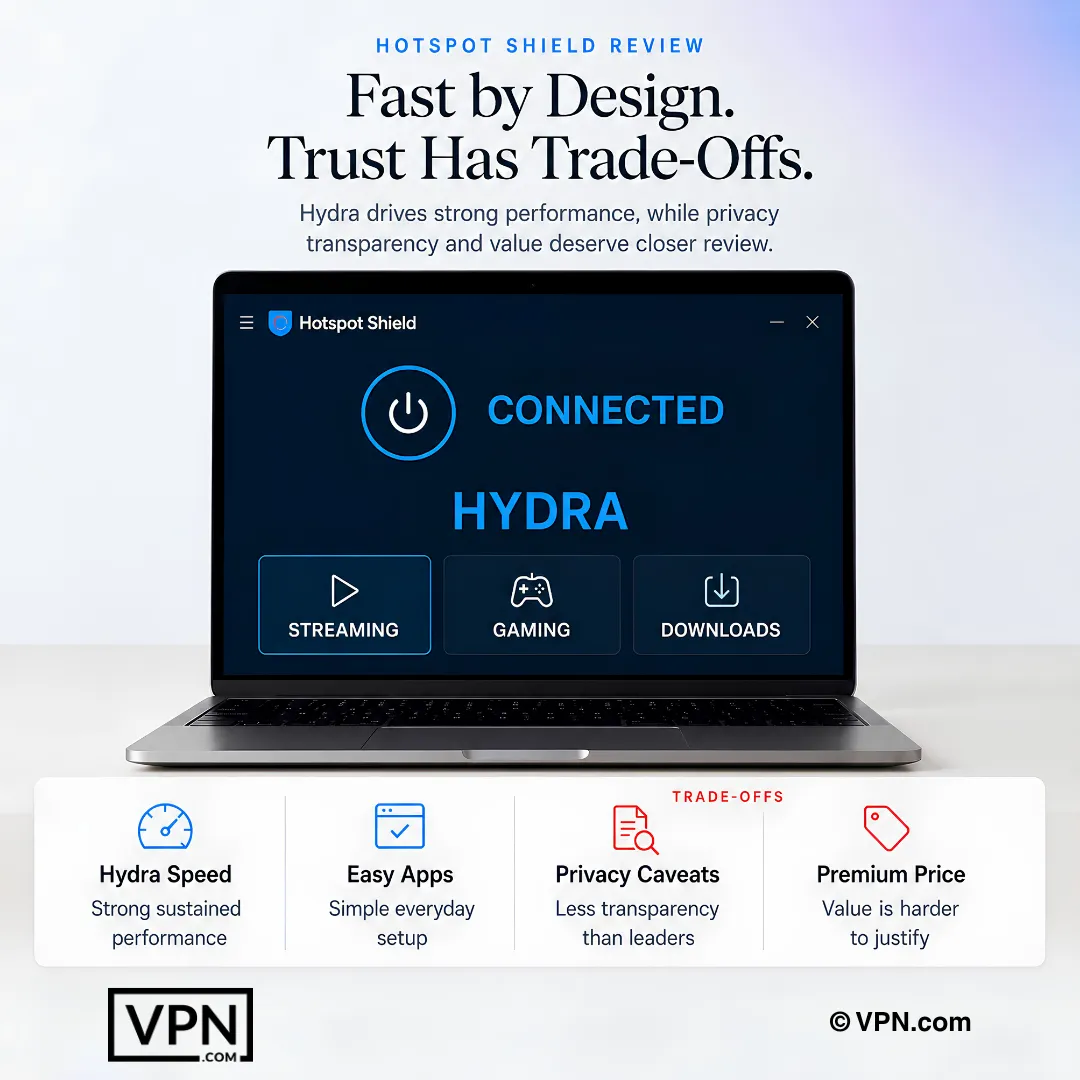
Hotspot Shield prioritizes Hydra-powered performance and easy apps, but privacy transparency and price require closer evaluation.
What is Hydra, and how is it different from standard VPN protocols?
Hydra is Hotspot Shield’s proprietary protocol, built on a TLS 1.3-derived transport layer that keeps persistent connections to cut handshake overhead on repeat sessions. Unlike open-source WireGuard or OpenVPN, Hydra is closed-source, so independent researchers can’t audit its code directly. Hotspot Shield also offers WireGuard, IKEv2, and OpenVPN as fallback protocols on supported platforms.
How fast is Hotspot Shield, and does that speed hold up on every protocol?
Hotspot Shield ranks #2 of 22 in our Speed Lab, aggregated from published third-party tests, largely thanks to its proprietary Hydra protocol. That advantage is protocol-specific, though: switching to standard options like OpenVPN or IKEv2 drops throughput by roughly 30-40 percent, per community benchmarks. Users who want Hydra’s full speed benefit need to stay on it rather than fallback protocols.
Does Hotspot Shield’s no-logs policy actually mean zero data collection?
No. Hotspot Shield’s no-logs policy carries caveats: its VPN privacy notice discloses logging of session duration, bandwidth, domain names visited (anonymised and aggregated monthly) and device hashes, which does not fully match its marketing. A 2023 Aon review commissioned by Pango found no indication browsing activity can be tied to a user, but only a four-page summary is published and its scope was limited to the privacy policy’s logging statements.
Why does Hotspot Shield’s US jurisdiction matter for privacy-conscious users?
Hotspot Shield is headquartered in the United States, a Five Eyes intelligence-sharing member, meaning US authorities can compel data disclosure through National Security Letters that often include gag orders barring the company from notifying affected users. Combined with the metadata retention built into its no-logs policy, this jurisdiction is a meaningful consideration for anyone prioritizing legal protection over raw speed.
Is the free version of Hotspot Shield actually private to use?
No, the free tier is ad-supported and explicitly collects device identifiers, approximate location data, and advertising IDs to feed targeted ads. That directly contradicts using a VPN for privacy. Paid plans add a kill switch, DNS leak protection enabled by default, and access to the Hydra protocol, none of which the free tier includes. Privacy-focused users should skip it entirely.
Can Hotspot Shield reliably access streaming libraries from all 125+ listed countries?
Not always. Many of Hotspot Shield’s 125+ country locations are virtual servers, meaning the IP address shows one country while traffic actually routes through hardware in another, which can cause a platform to detect the physical server location and block access. Netflix US, BBC iPlayer, and Disney+ work with reasonable consistency; Hulu and Prime Video are intermittent, and the app doesn’t label which servers are virtual.
Is Hotspot Shield’s promotional plan a good value compared to other VPNs?
It’s on the expensive side. Hotspot Shield’s cheapest rate is $7.99/month on its longest-term plan, with a much higher regular monthly price, and even the discounted rate costs more than several competitors offering stronger verified privacy credentials. You do get 800+ servers across 125+ countries and up to 25 simultaneous device connections on the Family tier, but the premium is hard to justify on privacy grounds alone.
How long do I have to request a refund if Hotspot Shield doesn’t work for me?
Hotspot Shield backs paid plans with a 45-day money-back guarantee, longer than the 30-day window most competitors offer. That gives you extra time to test Hydra’s speed advantage, verify streaming access to platforms like Netflix or Disney+, and confirm the kill switch and DNS leak protection behave as expected before committing to a longer term.
How many devices can I actually connect with Hotspot Shield?
It depends on your plan. Hotspot Shield’s Premium plan covers up to 10 simultaneous devices, while the Family plan extends that to 25, generous compared to the 5-10 device caps common among competitors. Split tunneling is available on Windows and Android to exclude specific apps from the tunnel, but that feature is absent on macOS and iOS due to platform restrictions.
What security features does Hotspot Shield include on paid plans?
Paid plans include AES-256 encryption, a kill switch across Windows, Mac, Android, and iOS, and DNS leak protection enabled by default. Hydra uses its own TLS 1.3-based encryption implementation separate from standard OpenVPN and IKEv2 connections. A 2023 Aon review commissioned by Pango covered only the privacy policy’s logging statements, and only a four-page summary is published, which limits independent verification.
Can I set up Hotspot Shield on my router for whole-network access?
Yes, but with a tradeoff: router-level setup requires manual OpenVPN configuration since the Hydra protocol isn’t available on routers, meaning you lose the speed advantage that defines the product. There’s no native Apple TV or gaming console app either, so router configuration is the main path to covering devices that can’t run the Hotspot Shield app directly.
What happens if I try to use Hotspot Shield in a heavily censored country like China?
Hotspot Shield doesn’t advertise obfuscation features built to defeat deep packet inspection, which restrictive networks in China, Russia, and Iran commonly use to detect and block VPN traffic. Travelers needing reliable access in censorship-heavy regions should research providers that specifically list obfuscated or stealth servers before departure, since Hotspot Shield offers no such guarantee.
Why does my Linux or browser-extension experience feel more limited than the desktop app?
Linux support exists through command-line tools only, with no graphical interface, unlike the polished Windows and Mac apps. The Chrome and Firefox browser extensions function as proxies rather than full VPN tunnels, meaning they encrypt browser traffic but leave other applications on your device unprotected. For full-device coverage on Linux, you’re limited to CLI configuration.
Evidence
The operator of Hotspot Shield, then named AnchorFree, published transparency reports in November 2017 and on 1 January 2019, covering 2016 to 2018, and committed to annual reports. PCMag confirmed in 2024 that the report for 2016 to 2018 exists and said it is hard to find.
Published: January 1, 2019·Accessed: October 3, 2026
Quote from the source, in the original English
AnchorFree is committed to releasing an annual report regarding the types of requests for information we receive from governments, law enforcement agencies, and other third parties
Published: November 29, 2017·Accessed: October 3, 2026
Quote from the source, in the original English
AnchorFree , a major VPN provider, just released its 2017 transparency report.
A complaint filed on 7 August 2017 by the Center for Democracy and Technology asked the US Federal Trade Commission to investigate Hotspot Shield Free VPN, then run by AnchorFree, for deceptive and unfair practices. It alleged logging beyond the no-logs claim, third-party tracking libraries, JavaScript injection and redirection of e-commerce traffic. These are allegations only; AnchorFree called them unfounded, and no regulator finding is recorded.
Published: August 7, 2017·Accessed: October 3, 2026
Quote from the source, in the original English
The Center for Democracy & Technology asks the Federal Trade Commission (Commission) to investigate the data security and data sharing practices of Hotspot Shield Free Virtual Private Network (VPN) services, a product of AnchorFree, Inc.
Contrary to Hotspot Shield’s claims, the VPN has been found to be actively injecting JavaScript codes using iframes for advertising and tracking purposes.
Published: August 7, 2017·Accessed: October 3, 2026· Archived copy
Quote from the source, in the original English
A complaint filed with the Federal Trade Commission (FTC) on Monday alleges that the popular free Virtual Private Network (VPN) service Hotspot Shield collects a large amount of data and intercepts user traffic.
Published: August 8, 2017·Accessed: October 3, 2026
Quote from the source, in the original English
The recent claims to the contrary made by a non-profit advocacy group, the Center for Democracy and Technology, are unfounded,
Hotspot Shield for Windows 10.3.0 and earlier had a local privilege-escalation flaw (CVE-2020-17365) and the AnchorFree VPN SDK before 1.3.3.218 had a SYSTEM-level code-execution flaw (CVE-2020-12828); the vendor listed both on its own Security Updates page. Both need local code execution first, so neither exposes browsing data remotely.
Published: September 24, 2020·Accessed: October 3, 2026
Quote from the source, in the original English
Improper directory permissions in the Hotspot Shield VPN client software for Windows 10.3.0 and earlier may allow an authorized user to potentially enable escalation of privilege via local access.
An issue was discovered in AnchorFree VPN SDK before 1.3.3.218.
Hotspot Shield, originally AnchorFree and later renamed Pango, was acquired by Aura on 7 July 2020, spun out of Aura as Pango Group on 3 September 2024, and merged with Total Security on 12 December 2024 into Point Wild, which lists Hotspot Shield among its brands. The current ownership statements are those of the companies themselves.
Published: January 6, 2025·Accessed: October 3, 2026
Quote from the source, in the original English
The combined company will rebrand itself as Point Wild, whose brands include Total AV, HotSpot Shield, UltraAV, Betternet, CyEx, Simpluris, and Comparitech.
We use cookies to understand how our site is used and, on some pages, to measure our ads. Accept to allow analytics cookies and personalized ads, or decline. If you decline, we only count visits without cookies. Privacy Policy