Best Enterprise VPN Solutions: 5 Platforms Compared
Compare enterprise VPN and zero trust platforms: NordLayer, Cisco, Palo Alto, Fortinet and Zscaler. See which fits your size, stack and IT team.
 Michael Gargiulo
Short answer: Match the platform to the network you already run. NordLayer is the quickest to roll out for a cloud-first team with no hardware to manage. Cisco Secure Client, Palo Alto GlobalProtect and Fortinet FortiClient make sense when you already run that vendor’s firewalls. Zscaler Private Access is the pick when the goal is zero trust app access rather than a network tunnel. NordLayer is the only one of the five we can send you to directly, and we say so below.
Which Enterprise VPN Should You Choose?
| If this describes you | Start with | Why |
|---|---|---|
| Cloud-first or hybrid team, no on-premise gateways, want it running fast | NordLayer | Cloud-managed gateways and a central Control Panel, with single sign-on and multi-factor authentication on every plan |
| You already run Cisco ASA or Firepower firewalls | Cisco Secure Client[1] | Built to work with Cisco’s own gateways |
| Security team wants deep traffic inspection at the firewall | Palo Alto GlobalProtect[2] | Extends Palo Alto’s firewall policy to remote users |
| You already run FortiGate firewalls and want one vendor | Fortinet FortiClient[3] | Pairs with FortiGate gateways and Fortinet’s endpoint tools |
| You want to replace broad network access with per-app access | Zscaler Private Access[4] | Zero trust model: users reach specific apps, not the network |
Get NordLayer plans and request a quote
How we picked, and what we do not do. VPN.com does not run its own performance or security tests. This guide is built from each vendor’s published product documentation and public security guidance, listed in the references below. VPN.com earns a commission if you buy NordLayer through our link. We have no affiliate relationship with the other four, so their links go to the vendors’ own sites.
What Makes a VPN “Enterprise”?
A consumer VPN protects one person’s connection. An enterprise VPN protects an organization’s access to its own systems: it adds central administration, identity integration, access policies that follow the user, and records IT can audit. For a smaller team (roughly 5 to 500 users), see our best VPN for business guide. This page is for larger or more complex deployments: multiple offices, existing firewalls, a security team, and procurement that asks for a quote rather than a checkout page.
Two architectures are in play, and the choice matters more than the brand:
- Network VPN. The user authenticates, a tunnel opens, and they reach the network resources policy allows. Cisco, Palo Alto and Fortinet are built around this, tied to their gateways or firewalls.
- Zero trust network access (ZTNA). The user is connected to individual applications, not the network. Zscaler Private Access is built around this. See our zero trust guide for the model.
NordLayer sits closer to the cloud-managed end: you use its hosted gateways rather than owning the hardware.
The Five Platforms Compared
| Platform | Best for | Deployment | Licensing |
|---|---|---|---|
| NordLayer | Cloud-first and hybrid teams | Cloud-managed | Per user, four plans (Lite, Core, Premium, Enterprise) |
| Cisco Secure Client[1] | Organizations on Cisco gateways | On-premise or hybrid | Through Cisco, typically bundled with other products |
| Palo Alto GlobalProtect[2] | Firewall-led security teams | Firewall-based or Prisma Access cloud | Through Palo Alto, tied to its firewall platform |
| Fortinet FortiClient[3] | FortiGate customers | On-premise or hybrid | Through Fortinet; confirm per-device or per-user terms |
| Zscaler Private Access[4] | Zero trust, app-level access | Cloud service | Through Zscaler; quote-based |
Licensing terms change and are negotiated, so this table describes the model, not a number. Ask each vendor for a quote against your real seat count.
NordLayer
Best for cloud-first and hybrid teams that want a managed service rather than hardware. NordLayer is the business product from Nord Security. Admins manage users and gateways from a central Control Panel, and single sign-on connects it to identity providers including Microsoft Entra ID, Okta, OneLogin, JumpCloud and Google Workspace. Apps cover Windows, macOS, iOS, Android and Linux, plus a browser extension. SSO and multi-factor authentication are available on all four plans (Lite, Core, Premium and Enterprise). NordLayer offers a 14-day money-back guarantee and no free trial, so run your pilot inside that window. This is the one platform here where VPN.com can send you directly.
Source: NordLayer’s own site and plan pages, checked 2 October 2026.
Cisco Secure Client
Best for organizations that already run Cisco firewalls. Cisco Secure Client (the successor to AnyConnect) connects to Cisco ASA and Firepower gateways and supports SSL/TLS and IPsec. Its strength is fit: if your gateways, identity tools and security operations are already Cisco, the client slots into that stack. If they are not, you take on that stack to use it. Licensing normally runs through Cisco or a reseller.
Palo Alto GlobalProtect
Best for security teams that run Palo Alto firewalls and want one policy for office and remote users. GlobalProtect connects users to Palo Alto firewalls or to its Prisma Access cloud service, so the same inspection rules and logging apply wherever the user is. Panorama is Palo Alto’s central management console for policy across many firewalls.
Fortinet FortiClient
Best for organizations standardizing on Fortinet. FortiClient pairs with FortiGate gateways and Fortinet’s endpoint management, so VPN, firewall and endpoint controls sit under one vendor. It supports IPsec and SSL tunneling. Check the current licensing terms with Fortinet, since they differ between per-device and per-user offers.
Zscaler Private Access
Best for cloud-heavy organizations committed to zero trust. Zscaler Private Access does not put users on the network. It brokers a connection between a user and a specific application through Zscaler’s cloud, so application addresses are not exposed to the public internet. If an account is compromised, the exposure is the apps that account was allowed to reach, not the whole network. It is cloud-delivered, so environments with a lot of on-premise infrastructure need a phased migration.
How to Choose: Six Questions
- What do you already run? Existing Cisco, Palo Alto or Fortinet firewalls usually decide this. A client that matches your gateways saves integration work.
- How many people, and how many sites? Many branch offices push toward firewall-based platforms. Mostly remote staff on SaaS tools push toward cloud-managed or zero trust.
- Who will administer it? A cloud-managed service needs less hardware expertise. Firewall platforms need a team that already knows the vendor.
- Does it connect to your identity provider? Confirm single sign-on and user provisioning work with the directory you use (Entra ID, Okta, Google Workspace).
- What does your auditor or insurer require? A VPN is one control among several and does not make an organization compliant on its own. Ask each vendor for its current audit documentation and check the report dates yourself.
- Can you pilot it? Run 25 to 50 users for a few weeks across at least two locations. Submit a support ticket and time the response.
Final Verdict
There is no single best enterprise VPN, only the best fit for your environment. Choose NordLayer if you are cloud-first and want a managed service with no hardware. Choose the Cisco, Palo Alto or Fortinet client if you already run that vendor’s firewalls. Choose Zscaler Private Access if your goal is zero trust app access.
Whatever you shortlist, run a pilot, ask for current audit documentation, and get a written quote for your seat count. See NordLayer plans if a cloud-managed option fits.
References
- Cisco. 2026. Secure Client (including AnyConnect). Retrieved September 30, 2026 from https://www.cisco.com/site/us/en/products/security/secure-client/index.html.Archived: Wayback Machine snapshot
- Palo Alto Networks. n.d. Secure Remote Access | GlobalProtect. Retrieved September 30, 2026 from https://www.paloaltonetworks.com/sase/globalprotect.Archived: Wayback Machine snapshot
- Fortinet. n.d. Product Downloads | Fortinet Product Downloads | Support. https://www.fortinet.com/support/product-downloads.Archived: Wayback Machine snapshot
- Zscaler. n.d. Transforming secure access with Zscaler Private Access (ZPA). Retrieved September 30, 2026 from https://www.zscaler.com/products-and-solutions/zscaler-private-access.Archived: Wayback Machine snapshot
- E. Barker, Q. Dang, S. Frankel, K. Scarfone, and P. Wouters. 2020. Guide to IPsec VPNs. NIST Special Publication (SP) 800-77 Rev. 1. National Institute of Standards and Technology. DOI: https://doi.org/10.6028/NIST.SP.800-77r1.Archived: Wayback Machine snapshot
- S. Frankel, P. Hoffman, A. Orebaugh, and R. Park. 2008. Guide to SSL VPNs. NIST Special Publication (SP) 800-113. National Institute of Standards and Technology. DOI: https://doi.org/10.6028/NIST.SP.800-113.Archived: Wayback Machine snapshot
- Cybersecurity and Infrastructure Security Agency CISA. n.d. Enterprise VPN Security. Retrieved September 30, 2026 from https://www.cisa.gov/news-events/cybersecurity-advisories/aa20-073a.Archived: Wayback Machine snapshot
- Fortinet. n.d. Enterprise VPN Solutions - Security, Control, and Flexibility at Scale. https://www.fortinet.com/resources/cyberglossary/enterprise-vpn-solutions.Archived: Wayback Machine snapshot
Resources for this page
Charts and reference images from our research, free to view and share.
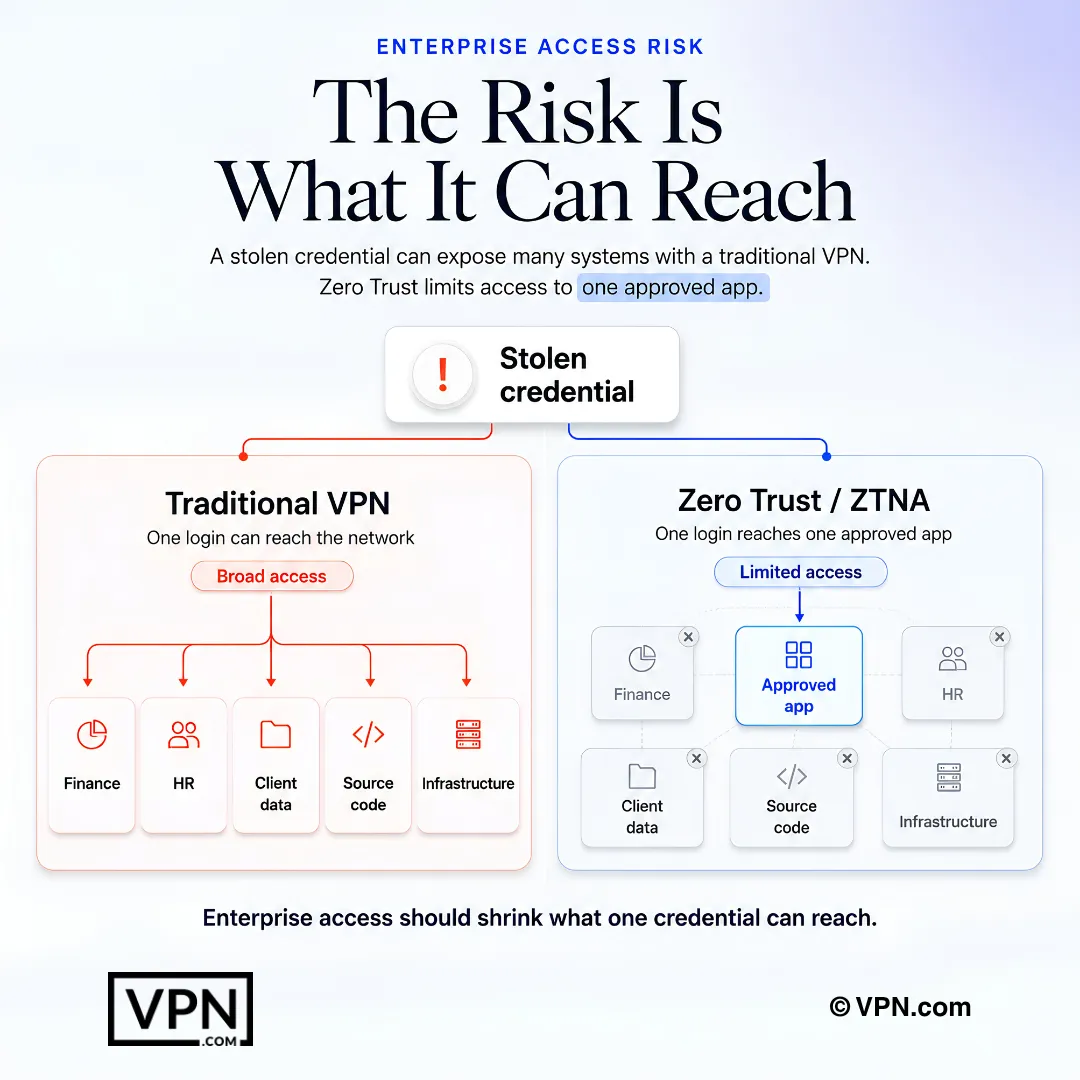
Enterprise access risk shrinks when one credential cannot reach the broader network.
Frequently Asked Questions
What is an enterprise VPN?
An enterprise VPN gives employees secure access to company systems through central administration, identity integration, access policies and audit logs. It differs from a consumer VPN, which protects one person’s connection and has no admin layer. Enterprise platforms are built for many users, multiple offices and an IT or security team.
What is the difference between an enterprise VPN and a business VPN?
Mostly scale and integration. A small-business VPN focuses on easy setup and multi-seat licensing for teams of a few to a few hundred. An enterprise deployment adds integration with existing firewalls, identity systems and monitoring, plus procurement through quotes and contracts. Many cloud-managed products serve both ends.
Is zero trust network access (ZTNA) replacing VPNs?
For some organizations, in part. A traditional VPN opens a tunnel that reaches the network the user is allowed on. ZTNA connects users to individual applications instead, which limits what a compromised account can reach. Many organizations run both during a transition. Zscaler Private Access is a ZTNA product; the others here are VPN-led.
Which enterprise VPN is best if we already use Cisco, Palo Alto or Fortinet firewalls?
Usually the same vendor’s client: Cisco Secure Client for Cisco gateways, GlobalProtect for Palo Alto firewalls, FortiClient for FortiGate. The client is built for that gateway, so you avoid integration work. If you run none of them, a cloud-managed option such as NordLayer avoids buying hardware.
How is enterprise VPN priced?
Mostly per user, per device, or inside a larger security agreement. Published list prices rarely match what a large buyer pays, so request a quote for your real seat count and ask what support level it includes. NordLayer lists four plans (Lite, Core, Premium and Enterprise) on its own pricing page.
Does an enterprise VPN make us compliant with HIPAA, SOC 2 or PCI DSS?
No. A VPN is one technical control, and compliance depends on your policies, configuration, vendors and evidence. Ask each vendor for its current audit reports or attestations, check the dates, and ask your compliance lead which controls your framework requires.
How should we run a pilot before buying?
Pick 25 to 50 users across at least two locations and run them for several weeks. Test sign-in through your identity provider, reliability on poor connections, admin workload, and support. Submit a real ticket and time the reply. With NordLayer, do this inside the 14-day money-back window, since there is no free trial.
Can employees use a consumer VPN for work instead?
It is a poor fit once a company needs central control. Consumer VPNs have no admin console, no way to enforce who connects to what, and no company-owned logs. A very small team sometimes starts there, but anything larger is better served by a business product. See our best VPN for business guide.
Which devices does an enterprise VPN need to support?
At minimum Windows, macOS, iOS and Android, and Linux for engineering teams. NordLayer lists apps for all five, plus a browser extension. For the others, confirm platform support and mobile device management compatibility on the vendor’s site.
What should we check if remote staff say the VPN is slow or drops?
Start with the gateway location and load, then the user’s local network, then split tunneling policy. Network VPNs that send all traffic through a distant gateway add delay, while cloud and zero trust options can route users to a nearer point of presence. Raise it with the vendor’s support during the pilot to see how they respond.